ZSvirt: what it is, what it promises, and where it fits
Last week I was in a WhatsApp infrastructure group and someone dropped a GitHub link with the line: “this one is going to cause a scene”. The repo was ZSvirt. In two weeks it had 1.7k stars, 305 forks, and three badges on Trendshift — including #1 Java Repository of the Day and #21 across all languages on August 16, 2026.
Outside Brazil, blogs are already publishing. Videos are already coming out. In Brazil, almost silence.
So I’m going to start this conversation here. This is the first article in a series about ZSvirt — what it is, how it works, what it promises, and where it might fit into the infrastructure you already run. No hype. No slideware. Feet on the ground, as usual.
The context you need first
If you manage infrastructure in Brazil in 2026, you already know what happened to VMware after the Broadcom acquisition in 2023. The model changed completely: perpetual licenses disappeared, free ESXi was discontinued, and the new per-core subscription pushed many companies — from SMB to enterprise — to reassess everything.
The market started looking for alternatives. And the first mass answer was Proxmox VE.
That was not by accident. Proxmox already existed, already had a community, already had production history — and for many people running VMware in small and medium environments, the migration made technical and financial sense. The project matured fast in this period: PBS gained maturity, SDN evolved, the Datacenter Manager arrived, the Brazilian community grew. Today Proxmox is a solid platform, with a real ecosystem and a proven reference for anyone leaving VMware without depending on a vendor license. I already wrote about this in the cost analysis and ROI guide VMware vs Proxmox.
But not everyone was running SMB. People with larger environments, teams used to the centralized vCenter management model, went looking for alternatives that kept that experience — and Nutanix AHV entered the conversation. Mature platform, curated interface, native migration with Move. The pitch made sense for anyone who wanted to stay in the enterprise model. The problem? Cost. Per-core licensing, validated hardware on the HCL, feature tiers — the math does not add up for the mid-market. And now, more and more, even people with enterprise budgets are rechecking whether the value delivered justifies the model. I detailed that comparison in Nutanix vs Proxmox: the project that made me rethink HCI for SMBs.
That is the setting — with Proxmox consolidated at the SMB edge and Nutanix still too expensive for much of the market — that ZSvirt showed up. Not as a replacement for either one, but as one more option, with a different pitch and philosophy. And that is exactly where it pays to pay attention.
What ZSvirt is — and where it came from
ZSvirt is not a college project. It is not a startup trying to reinvent virtualization from scratch.
It is the engine of ZSphere — ZStack’s commercial virtualization platform — released as open source under GPL v3.0.
ZStack was founded in 2015 in Shanghai, serves more than 5,000 enterprise customers in over 30 countries, and has the ZSphere platform running in production in more than 1,000 environments — finance, healthcare, education, manufacturing, transport. The engine you are looking at open source today has carried real workloads for years. It is not an MVP — it is their production engine, delivered as open source.
ZStack named the project ZSvirt and announced the launch on August 12, 2026 with:
- Full source on GitHub
- Signed installation ISO
- Public documentation
- ZMigrate — the VMware migration tool — included and free
- Public commitment: what is open source does not move to a paid tier. GPL v3 license, no change.
The positioning is direct: “source code isn’t enough” — so they shipped documentation, the architecture guide, migration guides, and a live demo you can use without installing anything.
Who is behind it and why they opened now
ZStack is a Chinese company with global operations. The timing was not random.
With the Broadcom/VMware licensing chaos, organizations are reassessing virtualization with a lens that did not exist before: code auditability, vendor freedom, long-term TCO control. ZStack saw that window and made a different play: instead of building an open source community from scratch, they opened an engine already validated in production at scale.
The response was immediate. In two weeks, beyond the GitHub numbers, there were already LinkedIn posts, a Quora thread comparing the management model with other platforms, and a GitHub Trending channel with 60k+ followers covering the project.
What it looks like in practice
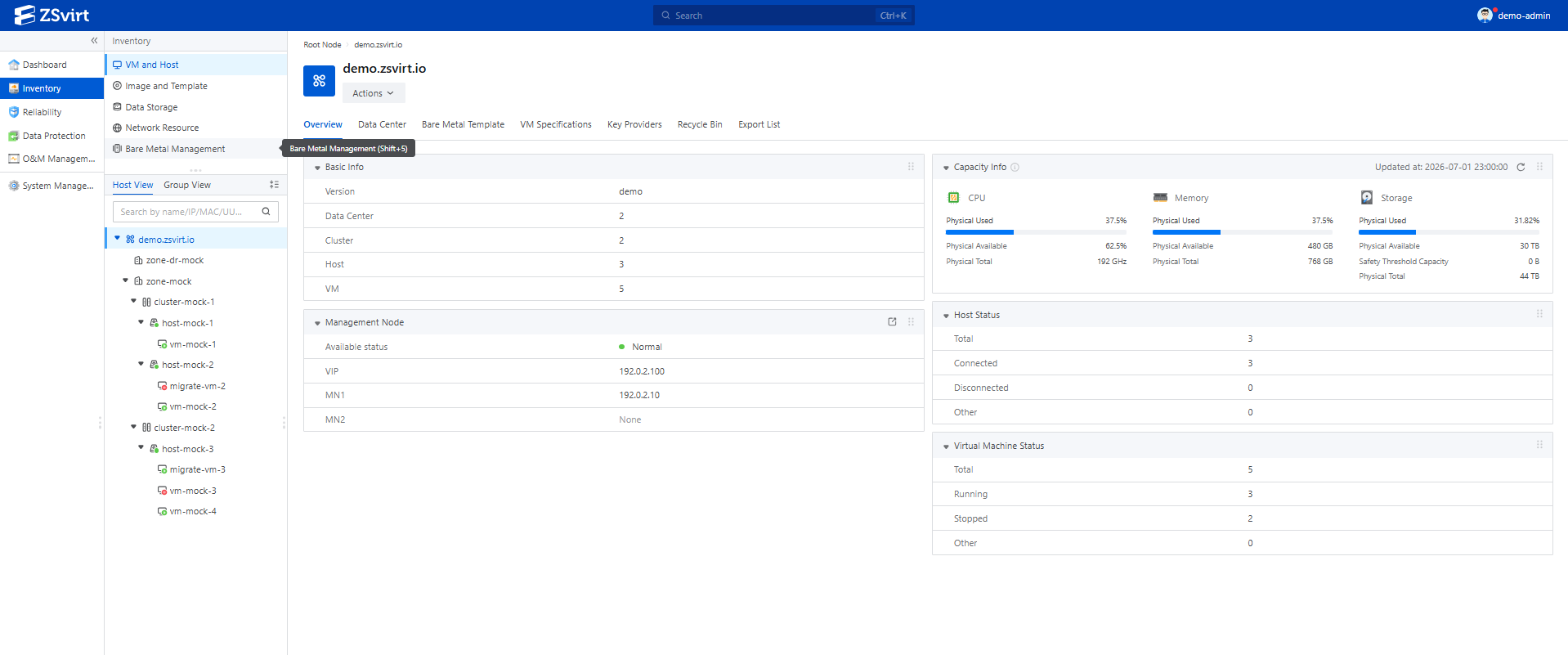
The side navigation organizes the environment into clear modules: Dashboard, Inventory, Reliability, Data Protection, O&M Management, System Management. Inside Inventory, the resource tree goes Root Node → Zone → Cluster → Host → VM. Each level has its own card with overview, capacity, connectivity status, and related objects.
The Management Node shows up exposed in the interface: VIP configured, MN1 and MN2 listed with their IPs. That already says a lot about the platform philosophy — ZSvirt has a dedicated management node, separated from the compute hosts. On the Root Node card you see at once: how many Data Centers, Clusters, Hosts and VMs the environment has, total physical CPU, memory and storage capacity, and the control plane status. All centralized, all visible from one point.
Anyone coming from Proxmox will notice the model difference on the first click. Anyone coming from vCenter or Prism will feel at home quickly. That is not coincidence — it is a positioning choice that becomes clearer in the philosophy section below.
The technical promises
Without marketing language — what the docs and code deliver as specification:
Declared scale: A single control plane managing 10,000+ hosts. VMs with up to 768 vCPUs. Compute overhead under 1%. A single server delivering 1M+ IOPS with sub-200μs latency.
Asynchronous framework: More than 2,000 REST/OpenAPI asynchronous endpoints. Long operations — create VM, migrate, provision storage — are broken into steps with automatic rollback. If VM creation fails on step 4 of 7, the previous three steps are rolled back. No orphaned disks, no hanging network config.
Stateless services: Control plane services hold no local state. That reduces failure points and simplifies HA for the management node itself.
Native VMware migration: ZMigrate is agentless — it operates at the virtualization layer without installing anything inside the source VM. Full-disk block copy with incremental background sync. Cutover can happen in an approximately 5-minute window. Supports up to 50 simultaneous online migrations. Offline import has no limit. There is a test-cutover mode: validates network, storage, boot, and resources before the real switch.
Security built in: Native Secure Boot (hardware root of trust on the VM firmware), vTPM 2.0 (isolated trusted key space per VM, Windows 11 ready), Native Key Provider (NKP) — keys generated, rotated, and stored in the cluster, no external KMS. Native VM Encryption, SR-IOV, east-west microsegmentation via Security Groups, MFA/2FA, immutable audit logs.
Automation: SDKs in Go, Python and Java. Terraform Provider. The 2,000+ REST endpoints are the automation surface — anything you do in the UI has a matching API.
Where it fits — my read
I’ll be direct: this is my interpretation after reading the documentation, exploring the live demo, and analyzing the architecture. Not absolute truth — it is the read of someone who lives infrastructure day to day and is evaluating where this project positions itself.
In my view, ZSvirt is not fighting for the same space as the better-known open source alternatives for people leaving VMware. The pitch is different: centralized and dedicated control plane, DC/Cluster/Host hierarchy managed by the platform, integrated operations UI, native migration included, enterprise scale validated in production. That profile is for people operating at larger scale, with teams that need centralized visibility and infrastructure automation — not for anyone who wants to assemble their own stack piece by piece.
Think of it this way: Proxmox is you building your own PC, picking each component. Nutanix is buying a MacBook Pro — it works, it looks good, but you pay for the integration and you do not swap the video card. ZSvirt is an enterprise workstation sold without reseller margin: the engineering already came done, tested in production, and you decide where it runs.
That combination — enterprise platform UX, no per-core license fee, no hardware lock-in, auditable code — is what makes me see ZSvirt competing in a specific market segment, not as a direct replacement for the more popular SMB alternatives.
But I insist: it is a read. In the next articles of the series I will deepen the technical comparison with more rigor. For now, what I can say is that the feature profile is not the same as a platform aimed at homelabs or lean SMBs — and that is not criticism, it is positioning.
Where it makes sense to evaluate:
- Environments that want to leave VMware without giving up a centralized control plane
- Teams that need to migrate many VMs without a long manual process
- Organizations that need infrastructure automation via API at scale
- Anyone who needs unified operational visibility without extra tools
Where ZSvirt has not arrived yet:
- Documentation still being built — English, no Portuguese yet
- A community weeks old — peer support is still limited
- Integration ecosystem growing
What you can do now
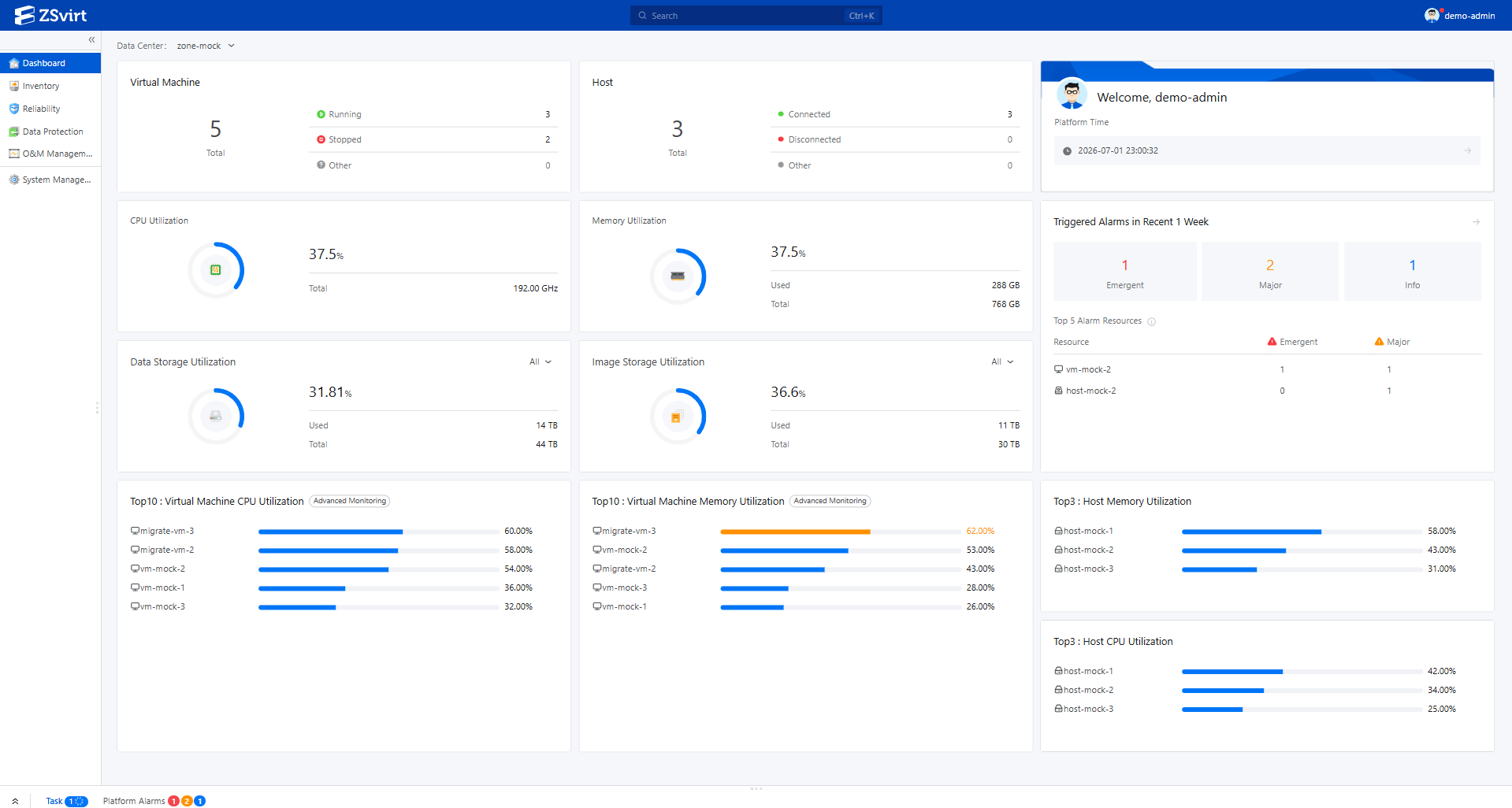
ZSvirt has a live demo at zsvirt.io — no install, just signup and login. I tested it for 20 minutes: you can explore the inventory, see the operational dashboard, understand the management model. Worth the time before any conclusion.
If you want to install, there are three paths:
- ISO for bare metal (5.41 GB, SHA256:
70146234229a0d62a7f21b252ef23cc96a2a55dc71f09186719451540f6b20d7) - OVA to import inside an existing VMware environment — you can evaluate the replacement inside the very environment you want to replace (17.02 GB, SHA256:
6c4c6bb483c2b002b30d63ba8eb4e743cc08d12c9aafd93d93333d86b634af50) - QCOW2 to run inside another KVM environment (24.02 GB, SHA256:
383099b3ad9cfd793dfd49e4b2dc99743832073d3c39e86deae91be59e5d9c3b)
The repository is at github.com/zsvirt/zsvirt. Open source, GPL v3, SHA256 available to verify the packages.
Why I am writing about this — and what comes next
One thing caught my attention beyond the platform itself: in Brazil, there is still almost nothing on ZSvirt. No technical video in Portuguese. Almost no articles. The window is open.
For me, as an infrastructure professional who serves virtualization environments of every size — from a micro company with a single host running four VMs to operations with multiple clusters, cross-site replication, dedicated DR environments, and dozens of clients managed in an MSP model — evaluating whether it is worth investing time in a new platform is a serious decision. Not a hobby. It is deciding where I put learning energy that will impact real projects, real proposals, and real clients. And the answer I reached is: yes. Not just for me — the Brazilian technical community deserves its own reference on this, in Portuguese, with real field context.
So I am proposing to do this in a structured way: build the lab, document each step, record the videos, and publish a complete series here on the blog. I am not going to wait for the platform to be “ready” or the international community to consolidate everything — I will build alongside, in real time, and bring it to the context we live in here.
In the next articles of this series:
- Engine architecture — how ZSvirt was built inside: async framework, workflow engine with rollback, stateless services, message bus.
- Technical comparison — an honest look at ZSvirt positioning against the main alternatives available today. No declared winner.
- ZMigrate in practice — the three VMware migration paths, a full checklist, what to validate after cutover.
- Lab from zero — install, configure, and first VM, with real screenshots from my environment and video.
If you are already evaluating ZSvirt or are curious, tell me in the comments. I especially want to know what doubts are coming up in a Brazilian context — hardware, network, integration with what the client already runs.
The series starts now.
Sources used in this article: ZSvirt on GitHub · zsvirt.io · ZSvirt VMware Alternative · ZSvirt Download · ZStack Press Release · ZStack — Two weeks after open-sourcing