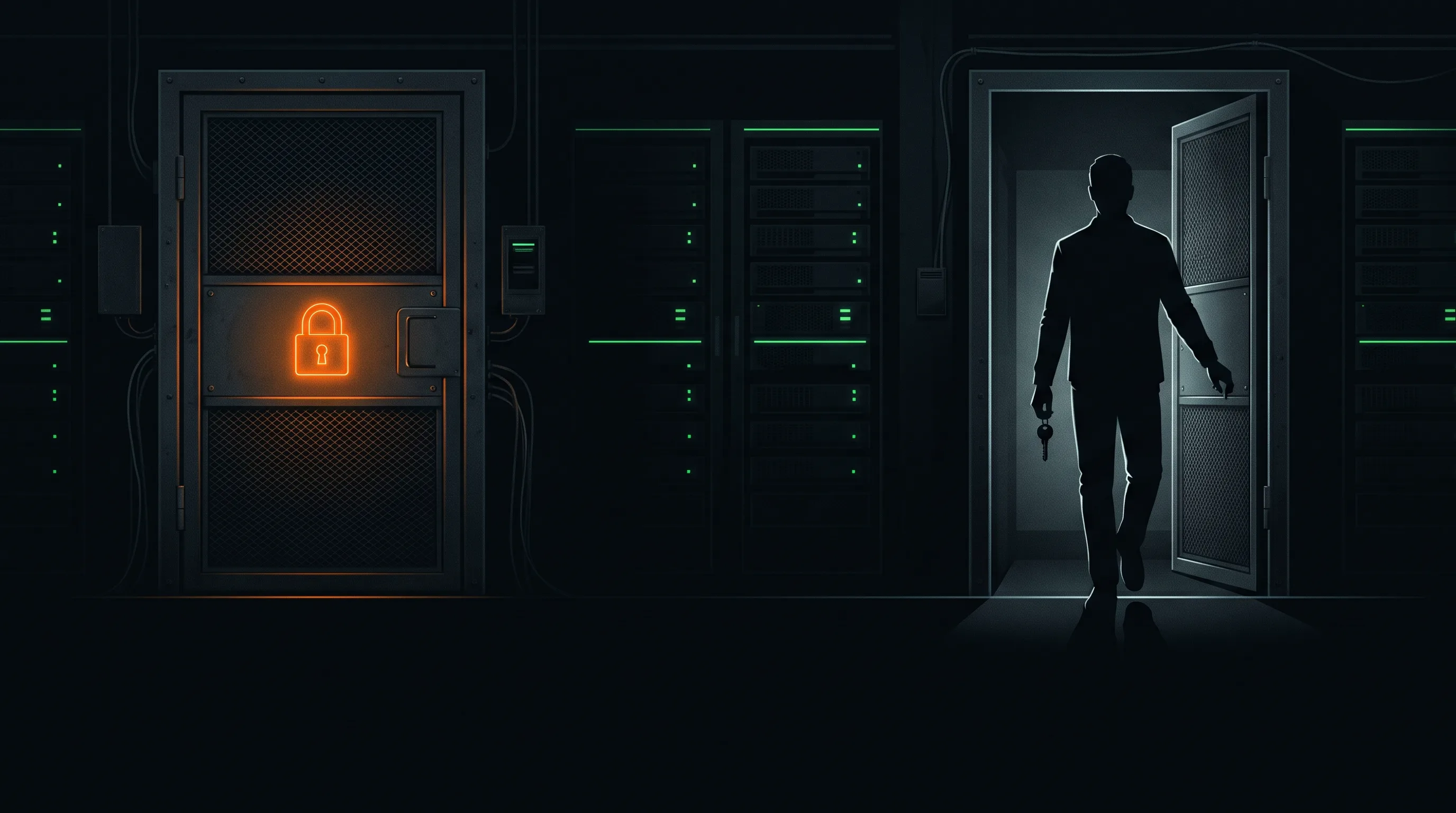
The firewall doesn't block whoever already has the key
On November 2, 2026, Mercado Bitcoin confirmed an attack that took deposits and withdrawals offline. Media estimates put the loss between $40 and $50 million across ten blockchains. The hot wallet was the target. The cold wallet did not fall. On November 9, the exchange reopened balance view with part of the affected assets locked — about a third of the total, based on what the company itself disclosed.
None of this failed because of a broken firewall. No ACL rule was brute-forced. No IDS screamed. The path was different: credential, session, transfer.
In the same month, the FBI attributed another incident — the theft of roughly $6.3 billion from Binance — to a North Korea-linked group, days before the Mercado Bitcoin case. Two operations. Neither depended on a 0-day at the perimeter.
This post is about the gap between what a firewall promises and what operations need. And about what you can do on Monday morning, with the team you already have.
The firewall is doing its job — and that is the problem
A firewall is a doorman. It controls who knocks and with which document. Egress rules block known C2. IPS signatures catch public exploits. That works, and it keeps working, against generic threats: the kind that sweep the internet waiting for someone without a patch.
The problem starts when the threat is not generic. When the adversary picked the target, read the org chart, and knows which email finance opens at 7pm. Then the doorman does not help: the visitor already has a badge.
I am not telling you to throw the firewall away. I am telling you to stop treating it as the complete answer. In environments I run, the firewall is almost always correct. What is wrong is the assumption that “protected” means “no need to look at the rest.”
Perimeter is a layer, not a system.
When I write this, I think of a client (an MSP with about 40 contracts) that measured firewall uptime like it was a security SLA. Firewall up 100%, green report. The VPN with a 2019 account and RDP open to the world sat in the same report, just in a tab nobody opened.
Social engineering at industrial scale
Proofpoint, in a May 2026 report, counted 12 CVEs from 2026 with confirmed active exploitation — against 8 that were in the CISA KEV catalog in the same period. More important than the count: the report highlights network perimeter devices among preferred targets. Firewall, VPN appliance, edge router. Exactly the equipment most people think solves the problem alone.
The cheapest vector is still people.
KnowBe4 published the Phishing by Industry Benchmarking Report in May 2025: a 33.1% baseline click rate in phishing simulation, dropping to 4.1% after twelve months of continuous training. That was 67.7 million simulations, 14.5 million users, 62,400 organizations. The improvement is real. So is the starting number.
The 2025 Phishing Simulation Benchmark from Fortra (a security and automation company, formerly HelpSystems), published June 2026, measured across 14 million recipients and more than 7,500 campaigns: a 5.42% click rate and a 1.99% password submission rate. The reporting rate landed around 10.5% — meaning close to 90% of clicks, nobody told anyone.
Kaspersky, on October 15, 2026, published a number that circulated out of context: 92% clicks on a single lure, the fake sanitary inspection report. That 92% measures one specific announcement, across 150,000 simulated emails between January and September 2026, in 120 countries. It is not a phishing average. Category averages were much lower: 45% in technology, 28% in healthcare and insurance, 26% in IT policy. The right read: right format, right moment, and even trained users fall.
The point of all these numbers is the same: the click is a symptom. The problem is the chain — email, credential, session, transfer — that the firewall cannot see. In a payment fraud incident, the email passed. The click passed. The password fill passed. What brought the operation down was the transfer authorized by someone who looked like (or was) the CFO.
And there is Fortra’s reporting detail: close to 90% of clicks, nobody raised a flag. The user failed in silence. No SOC alert, no IT ticket, no lesson for the team. That is in a corporate environment with formal simulation. In an SME with no phishing tests, silence is the default.
Training works, but it does not replace process
Back to the KnowBe4 number: 33.1% down to 4.1% in twelve months. That is a drop of more than 85%. Awareness training works. Anyone who says otherwise has not looked at the data.
What training does not do:
- Stop a legitimate CFO from authorizing a transfer under pressure
- Detect an attacker already inside Active Directory
- Replace network segmentation between finance and production
- Guarantee a perimeter patch ships in the same month as the CVE
Training covers the initial click. By itself, that is all it covers. The rest is architecture, process, and response.
In my day-to-day with SMEs, the pattern I see: the company trained the team last year, marked “done” in the spreadsheet, and never revisited it. Phishing simulation became an annual HR task, not a continuous security metric. The report sits in the drive. Incident response time is still “we find out when the user complains.”
When the person entering already has the key
In October 2026, The New York Times published a series on Alice Huang, a Chinese citizen and former Megaspeed executive. The company had bought roughly $4.8 billion in chips from Nvidia. According to the newspaper’s anonymous sources, US intelligence assessed that she was working for Chinese intelligence services. Nvidia opened an independent board investigation on November 8. Jensen Huang publicly acknowledged an intimate relationship and apologized to his family. The company’s board said it had no evidence of compromised secrets or national security. China rejected the allegations. Three Republican House committees requested a closed-door briefing, with a date pointed to November 18. In a BBC statement on the 9th, the president said the FBI is investigating the case.
I will not draw conclusions on an open case. What matters for people who run infrastructure is the pattern: long-term access, built on trust, no payload, no malware, no port scan. The firewall does not see it. The traffic is legitimate, the authorization exists, the purpose is the other one.
This shows up at corporate scale with state intelligence. In SMEs, the same pattern appears in a smaller size: a trusted supplier with remote access nobody has reviewed in two years, a former employee with an active VPN, an MSP with a domain credential that never rotated.
I have seen a case where the former server administrator (gone 18 months) still had a valid SSH key on the hypervisor. Nobody noticed because the access never failed. No firewall flags a legitimate session from a legitimate user. The access inventory was a stale spreadsheet in the founder’s drive.
The question is not “is our firewall up to date?” It is “who has a key today who should not — and how do I know?”
The CVE surface nobody patches
Proofpoint’s 12 actively exploited 2026 CVEs did not fall from the sky. They landed on perimeter appliances — the same equipment the company swore was “properly configured.”
The pattern I see in audits:
- VPN gateway on 18-month-old firmware
- Edge router with no defined patch window
- MikroTik or FortiGate with the management interface exposed to the internet
- Proxmox without security updates for three cycles
I do not need to name a specific CVE here. That is what official vendor advisories are for, and each one has its own URL. The point is structural: the perimeter is where old CVEs hurt most, because it is the exposed place.
And there is an operational detail almost nobody handles: the perimeter appliance is usually the last to get patched and the first to take traffic. Classic contradiction. The rule I use with clients: if the firewall has a monthly maintenance window, the security patch for the perimeter goes in the same window. No exception for “it is working.”
Whoever runs Proxmox and the edge at the same time knows how this slips: PVE updated, firewall forgotten. Or the reverse. Both layers need a single owner on the calendar — if it is two people, someone always assumes the other took care of it.
Checklist: what to do on Monday morning
What follows is process, not product. It works for MSPs, for SMEs with in-house IT, for anyone running Proxmox, FortiGate, MikroTik, whatever. Twelve steps. Most do not need new budget — they need an owner and a date.
Inventory of who has the key. List every active remote access: VPN, exposed RDP, SSH with key, supplier credential, MSP account. Each line with owner, creation date, and justification. No justification, suspend it.
Revoke ex-employee and supplier access. Check that offboarding removed access on the same day. If the process depends on someone remembering, the process is broken.
Segment finance from production. If finance and the file server share a VLAN with production, stop that. Simple rule: people who pay do not need SSH on the hypervisor.
Perimeter patch window. Fix a day each month for firewall, VPN, and router firmware. Write it down. Hit it. If you missed it, reschedule inside the same cycle — not the next one.
MFA on everything remote. VPN, hypervisor panel, email, MSP panel. No exception for “old client.” Old client is an argument to prioritize, not to exempt.
Continuous phishing simulation. Monthly, not annual. Measure click, password submission, and report rate — all three. Compare to last month. Gaming the number only makes the report pretty.
Transfer response training. Two-person rule above a defined amount. Confirmation channel outside email — a registered phone number, not the one that came in the message.
Quarterly MSP credential review. Including yours, if you are the MSP. Whoever administers the client environment cannot keep the same key for three years.
Management interface exposure. MikroTik, FortiGate, Proxmox panels: off the internet. Jump host or internal VPN. If outside access is needed, VPN with MFA — never ports 8006 or 8291 open.
Logs with an owner. Syslog or log panel with at least 90 days retention. Someone has to look. An alert without a reader is noise.
Written containment plan. What happens in the first hour of an incident: who isolates, who communicates, who decides to stop withdrawals or payments. Run a 30-minute tabletop exercise with the team. Paper beats intention.
Monthly metric for leadership. Three numbers: average perimeter patch time, % of accounts with MFA, phishing report rate. If it does not fit in three lines, it will not become a decision.
None of these 12 steps replaces a firewall. All of them depend on the firewall doing its job. Order matters: perimeter first, identity and process next, response last — but all three need to exist.
What I do not know
I do not know whether Mercado Bitcoin had proper network segmentation between hot and cold wallet. I do not know whether Binance failed on MFA or session detection. Cases under investigation produce incomplete narratives, and I would rather say that than invent a cause.
What I know, from years of working mostly with SMEs: equipment often out of date, a pfSense built on a ten-year-old desktop, and sometimes no in-house IT team at all. The incident that hurts almost never starts with a perimeter exploit. It starts with a credential, trust, or missing process. The firewall is there, doing its job. And you, what did you do the rest of the week?
If you only have energy for one thing, do step 1: the list of who has a key. Every remote access, with owner and date. Without that list, the other 11 stay in the air.
References
- Mercado Bitcoin. Attack confirmation and withdrawal suspension, November 2–9, 2026; O Tempo report, November 6, 2026.
- FBI / Binance. Attribution of ~$6.3B theft to a North Korea-linked group, November 2026.
- Proofpoint. Report on actively exploited 2026 CVEs (12 vs 8 in the CISA KEV), May 2026.
- KnowBe4. Phishing by Industry Benchmarking Report, May 13, 2025 — 33.1% baseline to 4.1% after 12 months; 67.7M simulations.
- Fortra (formerly HelpSystems). Phishing Simulation Benchmark 2025, published June 2026 — 5.42% click, 1.99% password, ~10.5% report rate.
- Kaspersky. Phishing by category, October 15, 2026 — 92% on a single sanitary inspection lure; category averages 45%/28%/26%.
- The New York Times. Series on Alice Huang and Nvidia, October 2026; Nvidia board investigation announced November 8, 2026; subsequent statements to Bloomberg and Reuters.
- BBC News. Statement on FBI investigation into the Nvidia case, November 9, 2026.